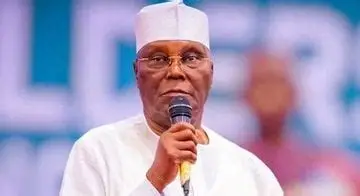
Atiku Abubakar wants Nigerians to know his government would move fast. "Within the first 100 days in office, I will create an Economic Stimulus Fund with an initial investment capacity of approximately US$10 billion to prioritize support to MSMEs across all the economic sectors," he told the Lagos Chamber of Commerce and Industry in 2022, ahead of the 2023 election. In August 2026, campaigning for 2027, he made essentially the same pledge again, this time framed as a $10 billion "startup fund" for young entrepreneurs, promising to shift Nigeria's youth "from unemployment to productivity."
The number has not changed since 2022. It had not changed then, either. At a PDP rally in Abia State that same election cycle, Atiku told supporters the $10 billion pledge for southeastern businesses was one he had first made in 2019, addressing traders in Aba. Three election cycles, one figure, and in each case, no published account of where the $10 billion would actually come from.
That absence was noticed the first time the number attracted real scrutiny. When Atiku unveiled the fund in 2022, Nigerians responding on social media pressed him directly: "The question is how would you raise such funds within 100 days? Selling public assets? How, Sir?" A private-sector group, the National Business Coalition, went as far as convening a panel specifically to work out financing and disbursement details after the fact, with its secretary telling reporters at the time that "Abubakar did not say how the fund would be generated" and that the group's job was to build the framework Atiku's own announcement had not included. There is no public record of that framework being completed, adopted by the campaign, or referenced in any of Atiku's subsequent statements on the fund, including the 2026 version.
The scale of the number is worth sitting with, because $10 billion is not a rounding error in Nigeria's fiscal picture. At the naira's official exchange rate in September 2026, roughly ₦1,321 to the dollar, $10 billion converts to about ₦13.2 trillion. Nigeria's entire approved federal budget for 2026 is ₦68.32 trillion, meaning Atiku's fund alone, raised inside 100 days, would equal close to a fifth of everything the federal government plans to spend across the whole of 2026. It would also dwarf the government's own borrowing plans for the year: the 2026 budget was built around $6 billion in new external loans for the entire fiscal year, a figure Atiku's proposed fund would exceed by 67 percent, in roughly a quarter of the time. Nigeria is already running a fiscal deficit projected at ₦20.1 trillion, or about 3.6 percent of GDP for 2026, with debt servicing alone consuming close to ₦15.9 trillion of the budget. A government inheriting that position and immediately layering on $10 billion in new commitments, whether through borrowing, asset sales or reallocated spending, would need to specify which of those paths it intends to take, since each carries a materially different cost to the same MSMEs and startups the fund claims to help.
There is also a basic question of what, exactly, is being promised in 2026 that was not already promised in 2022. Some recent reporting on Atiku's platform lists the pledge as a "₦10 billion economic stimulus fund," an order-of-magnitude currency error that has gone uncorrected in at least two outlets' coverage as of this month. Ten billion naira is roughly $7.6 million at current exchange rates, a figure so far below the $10 billion Atiku has actually stated in every direct quote on record that the discrepancy would matter enormously if either version were taken at face value by voters relying on secondary coverage rather than the candidate's own words. That confusion, however it originated, is itself worth noting: a promise repeated across three election cycles without a financing plan has apparently also gone three election cycles without careful enough scrutiny in parts of the press to catch a thousand-fold currency error in its own restatement.
Separately, Atiku's campaign has not clarified whether the August 2026 "startup fund" for youth entrepreneurs is the same $10 billion Economic Stimulus Fund rebranded with a different target audience, or a second, additional $10 billion commitment stacked on top of the first. The original 2022 version was aimed at "MSMEs across all economic sectors," including agriculture and manufacturing broadly. The 2026 version was announced separately, months later, specifically framed around startups and young founders, after Atiku met a delegation of N-Power scheme beneficiaries in Abuja. If it is the same fund, the campaign should say so and stop presenting it as two distinct policy announcements eighteen months apart. If it is a second $10 billion fund, the total first-100-days ask rises to $20 billion, roughly ₦26.4 trillion, and the financing question becomes twice as urgent as it already was.
None of this means targeted government support for small businesses is a bad idea, or that Atiku is wrong that Nigeria's MSME sector is underfinanced. But a number that has now survived three presidential campaigns unchanged, unfunded and unclarified is not a costed policy. It is a slogan with an impressively specific price tag. Atiku's campaign has had since at least 2019 to publish the financing mechanism his own supporters asked for in 2022. The question due before 2027 is not whether $10 billion would help Nigerian businesses. It is why, after six years and two elections, nobody outside the campaign appears to know where it would come from.
 WhatsApp
 X
X
 Facebook
 LinkedIn