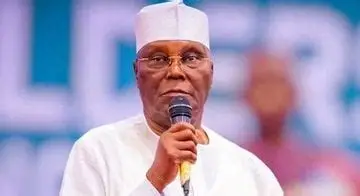
Atiku Abubakar's campaign moved fast after President Bola Tinubu defended the Nigerian Education Loan Fund on social media as evidence that his government had made education more affordable. Phrank Shaibu, Atiku's senior special assistant on public communication, dismissed the framing as dishonest: "You make education more expensive, lend students money to survive the increase, and then demand applause for the rescue. That is not affordability," he said, calling it "witchcraft economics." Atiku's position, as relayed by Shaibu, is that an ADC government would "reduce the underlying cost of education and, after review, provide forgiveness for qualifying student debts so that young Nigerians can graduate with hope rather than repayment burdens."
Two words in that sentence are doing almost all of the work, and neither has been defined: "review" and "qualifying."
NELFUND is not a grant program with a fixed budget that a future government could simply top up or wind down. It is structured as a revolving loan fund: the Student Loans Act establishes it as an interest-free lending scheme in which beneficiaries repay 10 percent of their salary, deducted at source, beginning two years after completing NYSC, with self-employed beneficiaries required to remit the same share of monthly profit. Those repayments are what is supposed to fund the next cohort of students once the initial capital, drawn from sources including the Tertiary Education Trust Fund, the Federation Allocation Account and recovered EFCC funds, is fully deployed. As of early September 2026, NELFUND has disbursed ₦355.87 billion to more than 1.65 million applicants since the scheme launched in May 2024, a loan book that has grown by roughly ₦150 billion in the past six months alone as disbursement accelerates.
Forgiving any meaningful share of that book does not make the underlying cost disappear. It transfers it: from the graduates who would have repaid 10 percent of their salary, to whatever source funds NELFUND's obligations to institutions and future applicants in the forgiven amount's place. Atiku's campaign has not said what that source would be, how large the forgiven portion is expected to be, or what specifically makes a debt "qualifying" as opposed to one that still gets repaid on the original terms. Without that criteria, "qualifying" could mean students from low-income households, students who studied in oversubscribed or underfunded institutions, students who never found employment after NYSC, or some other test entirely, and each of those definitions implies a completely different cost and a completely different group of Nigerians left still repaying while others are forgiven.
There is also a definitional question underneath the "witchcraft economics" framing that Atiku's campaign has not directly addressed. NELFUND loans already carry terms designed to be relatively soft by lending standards: no interest, no repayment obligation until two years after NYSC, and repayment capped at a fixed share of actual income rather than a fixed monthly instalment regardless of earnings. Calling the scheme "a liability" for graduates, as Shaibu did, is a different claim from calling it unaffordable or badly administered, and it is worth asking Atiku's campaign directly which of those is the actual objection: is the position that student loans as a category should not exist and tertiary education should instead be funded as a grant, or that NELFUND specifically has design flaws that make an otherwise reasonable loan model too burdensome, and if so, which terms would an ADC administration change rather than eliminate?
NELFUND has also drawn a distinct and more concrete line of criticism that Atiku's statement does not engage with at all. In 2023, the Independent Corrupt Practices and Other Related Offences Commission opened an investigation into a ₦71.2 billion gap between the ₦100 billion the federal government said it had released for the scheme and the ₦28.8 billion that had actually reached students at the time, alongside separate allegations that at least 51 tertiary institutions illegally deducted money from students' disbursed loan funds. That is a live accountability question about where NELFUND's money has actually gone, distinct from the affordability argument Atiku is making, and a candidate proposing to overhaul the scheme has an opening to address it that his campaign's statement so far has not taken.
This is the third Atiku promise this series has examined, after his fuel subsidy plan and his recycled $10 billion stimulus fund, and a pattern is becoming hard to ignore. In each case, the diagnosis of what is wrong with the status quo is specific and often fair: the old subsidy regime was corrupt, a $10 billion fund could genuinely help small businesses, students graduating into debt is a real burden. In each case, the proposed fix arrives as a label rather than a mechanism: a "production subsidy," a "stimulus fund," a "review" that produces forgiveness for the "qualifying." None of the three has yet come with a published number, a named criterion, or an identified funding source strong enough to survive the first follow-up question. Nigerian voters weighing Atiku's education platform are entitled to ask what they have already had reason to ask about his other major pledges this cycle: not whether the goal is good, but whether anyone in the campaign has actually costed it.
 WhatsApp
 X
X
 Facebook
 LinkedIn