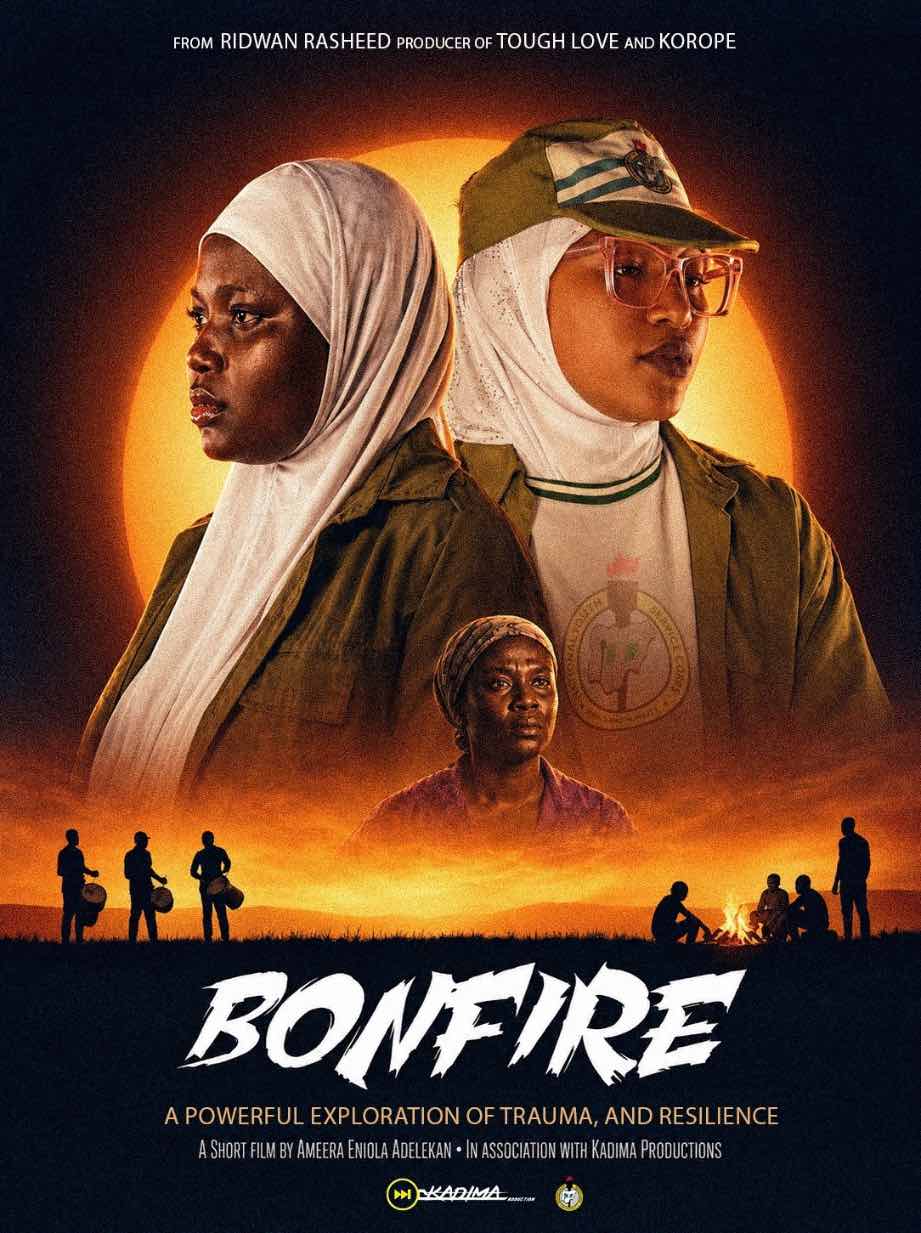
BON FIRE is four minutes long, but it does not present its subject in a way that can be easily summarized. The movie starts with Fatima sitting with a friend on what seems like an ordinary evening: there is music, the fire, and the general expectation that people should enjoy themselves. However, Fatima is not in a good mood.
Her friend notices this right away. Fatima is cold and distant, and she is clearly not interested in any of the guys around her. When asked what's wrong, Fatima finally explains that the evening is dragging her back to memories she definitely didn't want to recall.
From this point, BON FIRE becomes a story about memory.

Fatima remembers attending a high school camp and being excited about the bonfire. What she considered to be a harmless evening turned into something terrible when a camp official offered to walk with her. Fatima was naive enough to trust him, believing that he would protect her. Instead, he assaulted her.
Luckily for the film, the directors did not decide to show the assault itself. Fatima tells her story from her own perspective, and that is enough. We get to know how scared she was and how the image of the bonfire got stuck in her mind while she was experiencing the assault. The fire that was meant to be part of an entertaining evening is now associated with one of the worst memories in Fatima's life.
The best thing about BON FIRE is the connection between Fatima's behaviour in the present and the event that happened to her some time ago. Fatima says that she hates men and is ready to kill anyone who approaches her. It is not presented as a random feature of her personality but as something that developed from what happened to her.
Ameera Eniola plays Fatima in a convincing manner. Fatima is full of anger and exhaustion, and this makes her a credible character. She is not just waiting to share a sad story —- this is something she has carried for years. Her conversation with her friend feels like something she has always wanted to say but was never sure how to express.
Sometimes, the dialogue in the movie is a little too straightforward. Fatima has to explain a lot in a very limited period of time, and some of her phrases are too informative and sound unnatural for a real-life conversation. It is understandable considering that it is a four-minute movie, but it affects the credibility of some scenes.
Eleshinla Basirat has an easier role than Fatima, but the character is still very important. Fatima needs someone to talk to, and the presence of another woman gives the story some intimacy. Nevertheless, there is simply not enough time for their relationship to develop properly. We understand that the friend cares about Fatima, but we know little else about her apart from this particular conversation.
The most intriguing moment is when Fatima tells us about the end of her assailant's life.
The man eventually assaulted another girl, was caught, and brutally killed. Fatima saw his body. And she is not ashamed to admit that knowing about his suffering helped her survive.
That is the moment when BON FIRE does not give us an easy resolution.
The movie does not turn the death of the man who assaulted Fatima into a triumph. Fatima is not rejoicing in the way a revenge story would require her to. What Fatima tells us is much closer to a twisted kind of satisfaction. The man who destroyed the girl's life finally suffered himself, and knowing this helped Fatima live with the memory of what happened.
That is very uncomfortable, and it should be.
Sangokunle does not try to tell us exactly what we should think about Fatima's reaction to the assault. He lets Fatima talk and express her thoughts in her own words. Her response is defined by trauma, anger, and the fact that she did not get any kind of closure that could help her forget what happened.
Sangokunle's directing style is quite straightforward, and it suits the story. The use of music and fire creates a connection between Fatima's memories and the current situation without relying on special effects. It is also a good choice for a short movie in which the assault is not shown on screen — the horror comes from Fatima's description of what happened.
However, at the same time, four minutes is both the main strength and the biggest weakness of BON FIRE.
The short runtime helps to keep the focus of the film, but it also means that everything the directors want to say has to be compressed. Fatima's history, her relationship with her friend, the assault, her silence towards her parents, her attitude towards men, and the death of her attacker all have to be described within four minutes. All of these themes deserve more time.
The end of the movie comes too quickly, and I found myself wishing that Sangokunle had allowed his characters a few extra minutes of conversation. Maybe not to explain anything additional, but to show us better what the girl has become after this experience.
It does not mean that BON FIRE is a failure. It just shows the difference between having an interesting idea and having enough time to develop it properly.
What sticks with me is Fatima's attitude towards fire. She remembers how she looked at the flame when the assault happened, and years later, another fire brings that memory back. The image that was meant to symbolise celebration is now associated with fear. It is a simple but effective concept.
BON FIRE is not a perfect short film. Its dialogue is heavy with exposition, the supporting character is underdeveloped, and the story moves too quickly. But it has its own point of view, and, most importantly, it treats Fatima as a person who lives with the consequences of what happened to her rather than simply as a victim of tragedy.
Four minutes is not enough to tell everything about Fatima.
However, it is enough to show why she did not forget.
 WhatsApp
 X
X
 Facebook
 LinkedIn