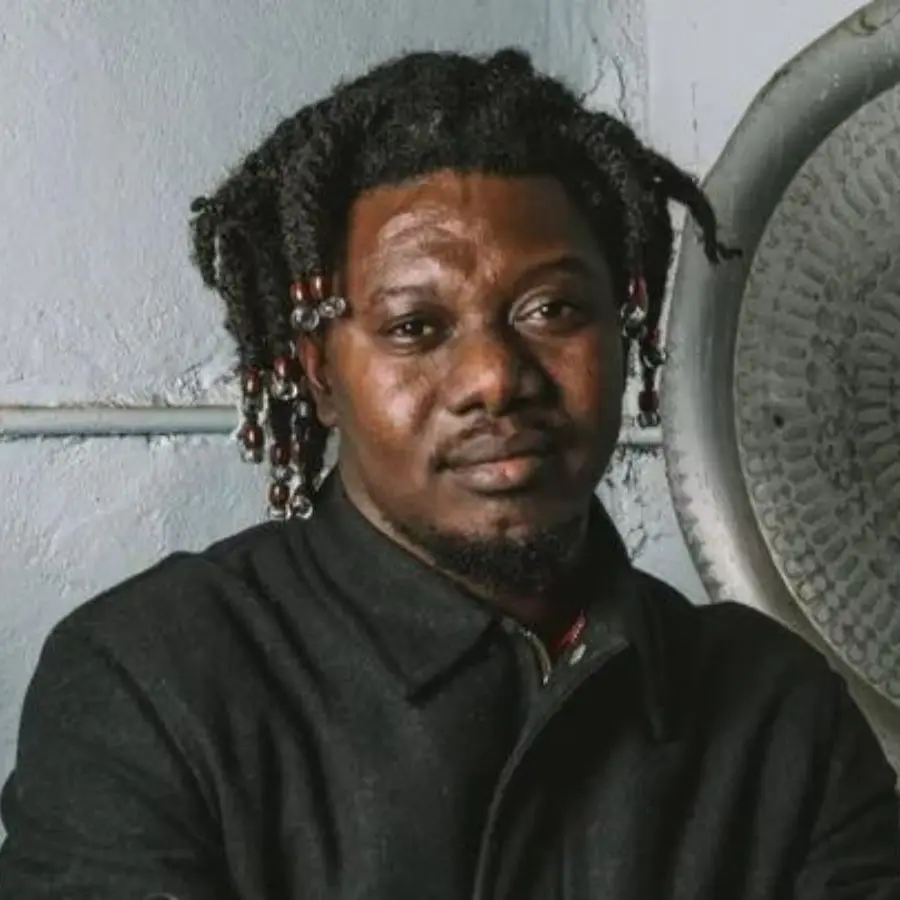
At the age of thirteen, Brymo recorded his debut single, aptly titled “Future.” Two decades later, most notably in the last nine years, it is glaring that he has embodied that title through his music releases.
However, the journey has never been smooth. It has been rife with ups and downs; from the disbandment of his childhood music group, “The Alien,” to the commercial failure of his Backstreet Boyz- and R. Kelly-inspired debut album, Brymstone, to his legal saga with Chocolate City Records, and many more. Brymo has seen it all, experienced the tide of life, but has never wavered. These crises did not diminish his musical output; rather, they formed the bedrock of his art, turning him into a philosopher, a seer and, usually, a storyteller.
With no big-label budget backing him, Brymo has largely self-funded his music career, leveraging Twitter to amplify his art and oftentimes engaging in face-offs with fans and fellow artists. He knows his way around Twitter, and his fan base, christened “Sigma,” is always on hand to egg him on. They are that loyal.
On May 27, 2022, Brymo released his new project, titled Theta, his eighth studio album since he left Chocolate City in 2013. Ten tracks, thirty-five minutes of a voyage through his state of mind, Theta is philosophical and thrilling.
“Illusions” takes the start. An ominous intro gives way to Brymo’s vocals underneath a punchy guitar pick. Brymo turns storyteller as he relates the story of Boyi, a young, ambitious and stubborn fellow who gets mired in a dysfunctional family. The story ends in murder and commendation. While Boyi slaves away in another man’s country, he encounters racism, which leads him to killing his boss. From the intro, Brymo takes the listeners through, on one hand, the 21st-century slavery currently being perpetuated by some Western countries. On the other hand, he takes a shot at the unfavourable conditions of their respective countries. Boyi becomes immortalised at the end of the song.
“Pim Pim” takes inspiration from Fela’s Afrobeat; from the horn to the agbamole drum, it is a tribute to Yoruba music. A large part of the song tilts towards motivating the listeners. The artist has been known for being stubborn with his convictions; here, he urges the listeners to be careful with their utterances. By the time the choral backing vocals come through towards the end of the track, it rises to another height.
Brymo explores strengths and individual qualities in the drum-driven “Dem No Born Us Together.” While the title could denote a situation between two lovers, it could also be a stark representation of agitation for independence by some sections or groups in Nigeria. Brymo might just have used the proverbial stone to kill multiple birds. One resounding attribute of this song remains the Afrocentric element splashed across it.
How do you love in a dull, poor economy? Say no more, Brymo has the answer. “Love Na Drug” is a representation of the duality of life. On one hand, he agrees that love is a drug, and on the other, he goes in the opposite direction. He later delves into the intricacies of love, the economy, people, war and more. While he might tend to sound philosophical, the topic doesn’t allow him to do much. Beyond love, he takes some shots at perceived doubters.
“Money Good” could have been an Afrobeat track: all you need to do is scrap the mid-tempo production for a perkier one. On this track, Brymo shows his debt to pop music. The lyrics, as well as his delivery, slightly depart from the previous four tracks. “Money Good” is one of the shortest tracks, and it is straight to the point.
Some fragments of Hip-Hop and Jazz are scattered throughout the production of “Life Dey Go.” From the first line to the last, Brymo tells a coming-of-age story. For an artist who has fought establishments, left one of the foremost indigenous Nigerian record labels amidst controversy and recently faced an allegation of rape, “life was surely going on.” While he battles with all these, he sometimes lives in the illusion that he isn’t hurt. This is one of his coping mechanisms. “Life Dey Go” is all shades of personal struggles, battles and triumphs. A lot of people would find it relatable.
The pessimism of the previous tracks gives way to a positive and light-hearted Brymo on the next track, “Tomorrow.” Over thumping drums and bright trumpet, Brymo takes the wheel as he eggs the listener on with encouraging affirmations: “All your problems temporary / You go succeed miraculously / Make e no hold you back.”
The electro-pop track “Oga” details a conversation between an executioner and a man who is about to be executed.
“Market Square” might be another name for Twitter, where issues are debated and judgment delivered without hearing from the second party. When Brymo says he would go to the market square to get justice, he mocks these people and their crude antics. “Market Square” takes a cue from different instances, examples and scenarios, with the 2020 rape allegation and his recent tiff with 2Baba coming to the fore. Right now, the market square is in vogue; it gets amplified by the recent trend of cancel culture. Artists like Brymo and D’banj were once victims.
The album reaches its nadir on “For You,” a gorgeous take on love, driven by traditional instruments.
Theta is a concise, well-structured musical meal from Brymo. He retains his pristine pen game while incorporating African and Western production. The fans have something to listen to and enjoy until he releases another project next year. Music critics have found another opportunity to debate where this album falls when compared with Brymo’s other greats, like Oso, Yellow and Merchants, Dealers & Slaves.
 WhatsApp
 X
X
 Facebook
 LinkedIn