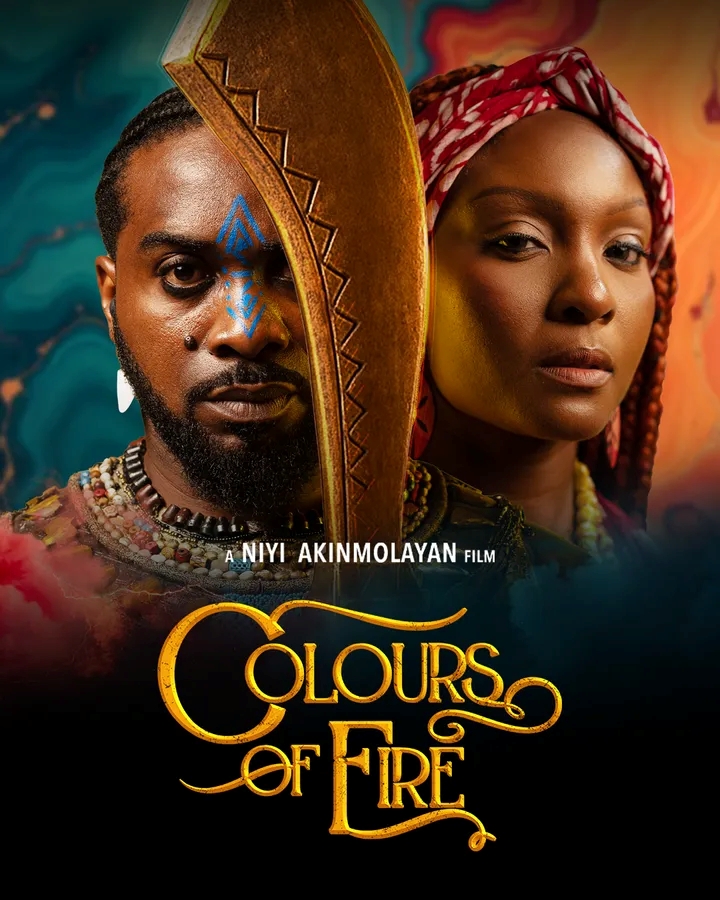
In the first place, Niyi Akinmolayan's Colours of Fire is one of those Nigerian films that attract you even before you find out whether they work or not. There are warriors, rival tribes, magic, love, beautiful costumes, mythical creatures, and other exciting elements involved. Apart from that, the film is quite different from most of what we have seen in Nollywood recently.
At the same time, this is the main strength of the movie as well as one of the causes of its weaknesses.
Released in cinemas on 24 December 2025, Colours of Fire tells the story of Akinbode (Uzor Arukwe), a warrior belonging to the Blue Tribe who is ordered by his chief to deal with a creature allegedly released by their rivals, the Red Tribe. Akinbode's mission takes him into the territory of the tribe which he has been taught to fear throughout his life, and there he meets a girl named Moremi (Osas Ighodaro).

As a result, the film reveals that the confrontation between the tribes has a complicated origin and is based on fear and misunderstanding.
It is a good starting point for the film. Of course, such an idea is quite common in movies. However, Colours of Fire presents it inside its own universe, which combines colour, culture, and power. Akinbode has grown up believing that he knows who his enemy is, but the situation changes when he meets Moremi. Their romance becomes crucial because of this, rather than being only a forbidden love story.
Unfortunately, sometimes the screenplay cannot give enough space to these ideas. There are some parts of the film where the characters say things aloud which would have been better revealed through their actions. There is plenty of information to reveal, and sometimes it seems that the film wants to explain its mythology instead of giving it enough opportunity to develop.
It is especially noticeable in the middle of the movie. Some dance sequences, long conversations, and visual effects interrupt the plot at the very moment when it should move forward. We also need to address the film's pacing issues and the amount of information that the audience has to process.
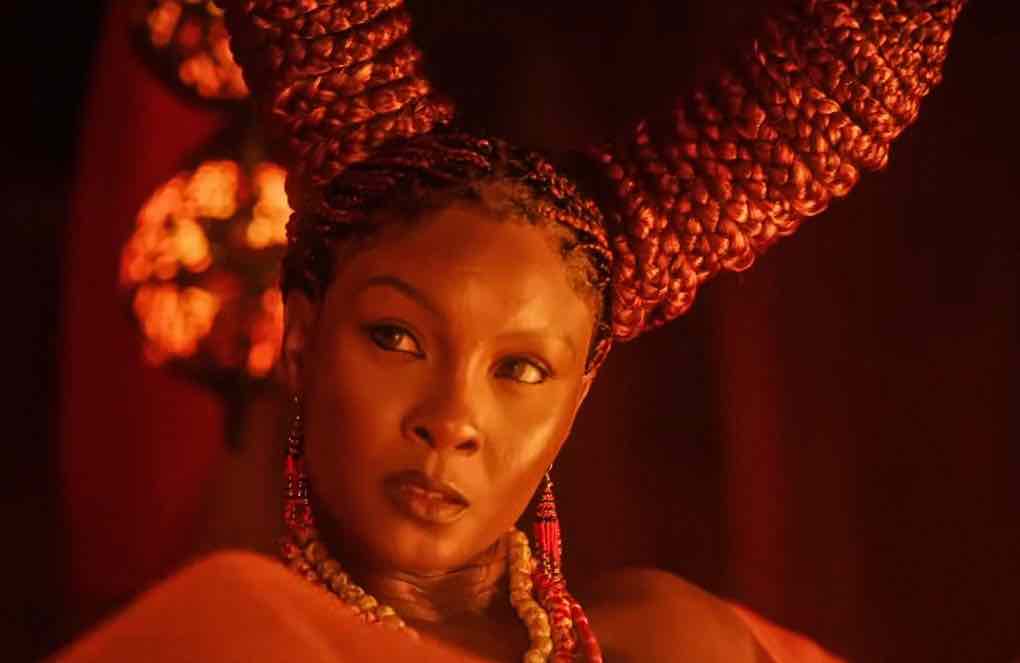
Anyway, the performances help. Uzor Arukwe gives his character an appropriate serenity, and it is quite impressive to see how Akinbode gradually changes his views without losing what defines him. Osas Ighodaro is convincing in her performance, too. She has a good screen presence and is better when she does not need to say anything. Her dance scenes are also among the best parts of the film.
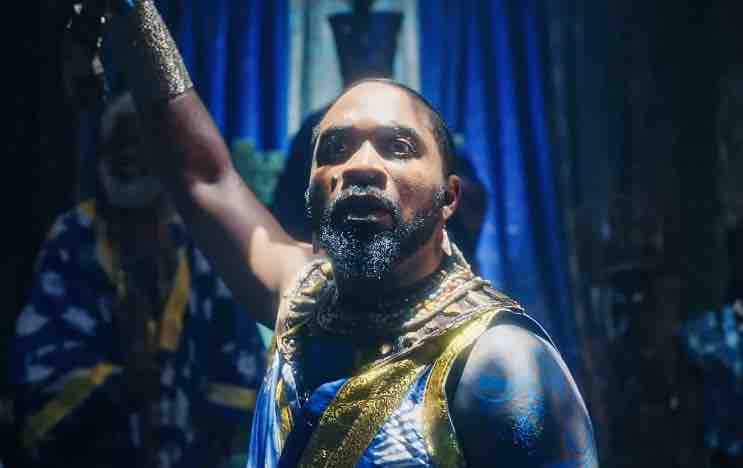
Gabriel Afolayan, Femi Branch, Mercy Aigbe, and Ibrahim Chatta bring energy to the supporting cast.
Nevertheless, the best thing to notice in Colours of Fire is its production.
It starts with the costumes, which deserve admiration. They are not subtle in their use of colour, but they give the film a special look. Blue and red become evident in the costumes, architecture, props, and other details.
The production design makes the characters' world unique and helps to separate the two tribes visually.
There are, however, some doubts about the visual effects of the film. Akinmolayan wants to go beyond the ordinary live-action movie and uses animation, green-screen environments, CGI, and AI-generated visuals. Sometimes, they really help to create things that would have been difficult to present without these technologies.
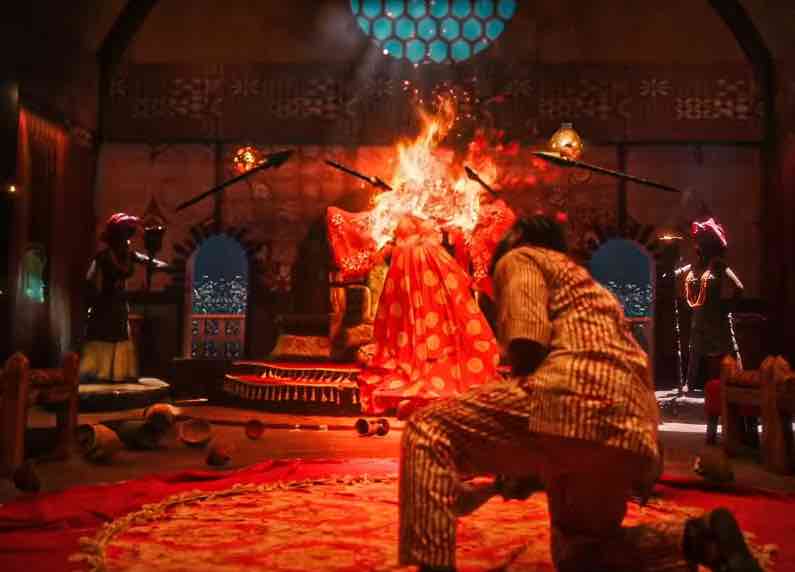
However, sometimes things become worse. The problem is not connected with the use of technology itself. It occurs when the technology becomes more visible than the scene. Some of the film's digital effects do not fit comfortably with the actors and physical sets.
The creature, which is the main point of the story, can be an example. It is presented as something important and frightening, but its revelation somehow fails. In other words, the more the film tries to prove the importance of the creature, the more obvious the special effects become.
Apart from that, there is some problem with the film's ending. Having spent so much time creating its world and describing the conflict between the tribes, the movie goes through its resolution quickly. Some emotional aspects of the plot suffer as a result.
This makes Colours of Fire disappointing in some respects.
There is an evident director behind the film who wants to create something new for Nollywood. Moreover, the film is not short of ideas or effort. It is not short of visual ambition, either.
What it lacks, however, is some restraint.
Every element of the movie wants to attract the audience's attention: costumes, effects, dance scenes, mythology, and even dialogue. It results in an interesting visual experience, which sometimes becomes surprisingly thin.
I prefer to see a Nigerian filmmaker trying something new rather than returning to something traditional and safe. Colours of Fire proves that Nollywood is ready to give a fantasy movie enough imagination and ambition to create its own universe.
Nevertheless, ambition is not enough to hold a film for two hours.
It tells a good story about fear, tribal confrontation, manipulation, and the consequences of believing everything you're taught over a lifetime. The film sometimes become too touching but usually hides such feelings under the spectacle.
Colours of Fire deserves attention for its attempts, including its costumes, production design, and performances. As a movie, however, it needed a more concise screenplay and more confidence in the story beneath all the spectacle.
 WhatsApp
 X
X
 Facebook
 LinkedIn