What happens when a family spends generations believing that something terrible has been passed down to them?
For the Falodun women, the answer is marriage. Or, at least, that is what they have been told.
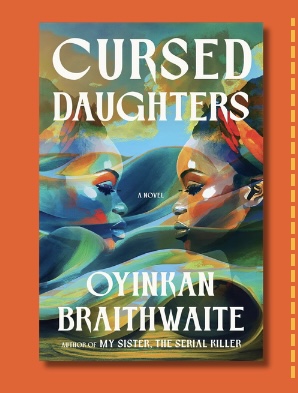
In Oyinkan Braithwaite’s Cursed Daughters, a curse laid on an ancestor becomes the explanation for a long line of failed relationships. The women of the Falodun family cannot seem to escape disappointment in love. Husbands leave. Relationships collapse. Affection becomes complicated by suspicion and fear. Each generation grows up knowing that something happened before them, something that may have determined what happens to them.

But Braithwaite is careful not to settle the question of whether the curse is real.
That uncertainty is central to the novel. Cursed Daughters does not ask the reader to choose between superstition and rationality. Instead, it keeps both possibilities alive and allows them to disturb each other.
The story moves through three generations, with cousins Monife and Ebun and Ebun’s daughter Eniiyi at its centre. The family history begins with Feranmi Falodun, a man whose decision to marry a second woman without properly ending his first marriage sets the curse in motion. The unnamed first wife has travelled from the city to the village to bury her father. Feranmi seduces her, marries her, then leaves under the pretence that he must go and pay obeisance to the chief. He never returns.
When the two women eventually meet, they fight. The first wife is wounded. She wipes blood from her injuries and smears it onto the ground before pronouncing her curse on Feranmi and the women who will come after him.
“It will not be well with you... Your daughters are cursed... Your granddaughters will love in vain... Your great-granddaughters will labour for acknowledgement... Ko ni dafun e.”
The curse travels down the family line.
There are five Falodun women at its centre: the sisters Bunmi and Kemi, their daughters Monife and Ebun, and Eniiyi. Each woman has a different relationship with the family story, but none is completely free from it.
This is where Braithwaite makes the novel more interesting than a conventional story about a family curse. She does not give the reader a priest, scientist or narrator who can finally explain what is happening. The supernatural remains possible, but so does psychology.
Monife asks, “what if the curse believes in you?” It is one of the novel’s most important questions because it shifts attention away from whether the curse exists. A person who believes she is cursed may behave differently from someone who does not. Fear can become habit. Habit can become behaviour. Behaviour can begin to resemble fate.
Eniiyi offers another possibility. Perhaps what the family calls a curse is inherited trauma. Perhaps the women are carrying psychological and even biological consequences of generations of pain. What if the trauma of losing the love, stability and social standing associated with marriage leaves a mark that is then passed on?
Neither explanation completely defeats the other.
The result is a novel that understands something uncomfortable about belief. You do not necessarily have to prove a superstition for it to shape your life.
This is particularly interesting in the Nigerian context, where Christianity and Islam exist alongside older indigenous beliefs that have never entirely disappeared. Modern Nigerian life is full of these contradictions. Someone can dismiss traditional spiritual practices in public and still privately worry about what they cannot explain. A person can pray in church or mosque and still wonder whether a family misfortune has a spiritual explanation.
Braithwaite understands that this tension does not have to be resolved. It can simply exist.
The curse becomes a way of giving narrative form to that uncertainty.
But there is another inheritance operating beneath the supernatural one. The Falodun women are not simply haunted by a curse. They are haunted by the idea of marriage itself.
Much of their emotional and existential lives revolves around men, whether the men are present or absent. The women want relationships, fear relationships, leave relationships and obsess over relationships. Even the attempt to escape the family pattern keeps marriage at the centre of the conversation.
This may be the novel’s more convincing curse.
Marriage promises love, companionship, stability and social legitimacy. When it fails, the loss is therefore larger than the relationship itself. It can feel like the loss of an expected future. The Falodun women inherit not only a warning about men but an entire way of measuring their lives through them.
In this sense, the supernatural curse and the social expectation reinforce each other. The more the women believe that marriage determines their fate, the more powerful the curse becomes.
Braithwaite also uses music to quietly establish the passage of time. Songs become markers of the changing Nigerian cultural landscape. Pliers’ “Murder She Wrote,” Snoop Dogg’s “Gin and Juice” and Brandy evoke an earlier period, while Burna Boy’s “Last Last” and “Gbona,” Teni’s “Case,” Lojay’s “Monalisa” and Ayra Starr’s “Bloody Samaritan” locate the later sections in a recognisably contemporary Nigeria.
There is also a middle period, represented by Janet Jackson’s “Doesn’t Really Matter” and Lagbaja’s “Coolu Temper.”
The music changes. The country does not change as much.
NEPA still interrupts ordinary life. Electricity remains unreliable. Air conditioners stop working. Eniiyi can still find herself sweating in 2024 or 2025 because there is no power. The passage from one generation to another therefore becomes more complicated. Technology, music and popular culture move forward, but some of the basic conditions of Nigerian life remain stubbornly familiar.
The same contradiction appears in the political atmosphere. There is little confidence in the political process, even as national symbols change and economic hardship deepens. The change to the national anthem, occurring against a backdrop of economic anxiety, becomes another reminder of the distance between symbolic gestures and everyday reality.
The drowning of Zubby at a Lagos beach is even more direct. Eniiyi does not know the emergency number for an ambulance, or even whether there is one. It is a small detail, but Braithwaite turns it into something larger. The failure to know whom to call in an emergency becomes a miniature portrait of a country where institutions that should provide basic protection often feel distant or unreliable.
These details prevent Cursed Daughters from becoming only a domestic story. The family is also a way of looking at the country.
Yet the novel is not without weaknesses.
Braithwaite’s treatment of Nigerian Pidgin is one of them. Some of the dialogue, particularly from the Priestess and Mama G, does not always sound convincing. Phrases such as “I cannot resell am” feel constructed rather than spoken. A Nigerian speaker might naturally say something closer to “I no go fit sell am give another pesin.” Elsewhere, expressions such as “E don happen in the spirit world” and “No be small matter at all; but I can start to beg the gods for her sake” appear to be reaching for a Nigerian cadence without fully reproducing its rhythm.
The problem is not simply grammar. Pidgin has its own syntax, timing and music. When that rhythm is missing, a character can begin to sound like an outsider’s approximation of Nigerian speech.
This matters particularly with Mama G, whose voice could have carried more personality and social texture. Instead, some of the dialogue flattens her into a representation of an idea rather than allowing her to become fully herself.
Still, the novel's larger achievement survives these weaknesses.
The Falodun women spend much of Cursed Daughters trying to determine whether they are trapped by something outside themselves. Is it the curse? Is it trauma? Is it family conditioning? Is it the expectation that a woman’s happiness must eventually be validated by a man?
Perhaps it is all of them.
The most compelling possibility is that the supernatural curse works because it has been joined by a social one. Once a family has told its daughters that they are destined to suffer in love, every failed relationship can become evidence. Every disappointment confirms the story. Every new generation inherits the fear before it has the opportunity to question it.
That is why the ending matters.
In the epilogue, Monife is left wrestling with the monstrous image of the curse in the ocean, while Eniiyi is on a plane, physically and symbolically moving away from it. One woman remains engaged with the thing that has haunted the family. Another appears to be loosening herself from its grip.
The distinction is important. Breaking an inherited pattern does not necessarily mean proving that the pattern was never real. Sometimes it means refusing to organise your life around it.
Cursed Daughters is ultimately less interested in proving whether the Falodun women are cursed than in asking what happens when a belief becomes an inheritance. Braithwaite understands that families pass down more than names and possessions. They pass down fears, expectations, wounds and explanations.
Some of those inheritances can be survived.
And perhaps that is the real escape.
 WhatsApp
 X
X
 Facebook
 LinkedIn