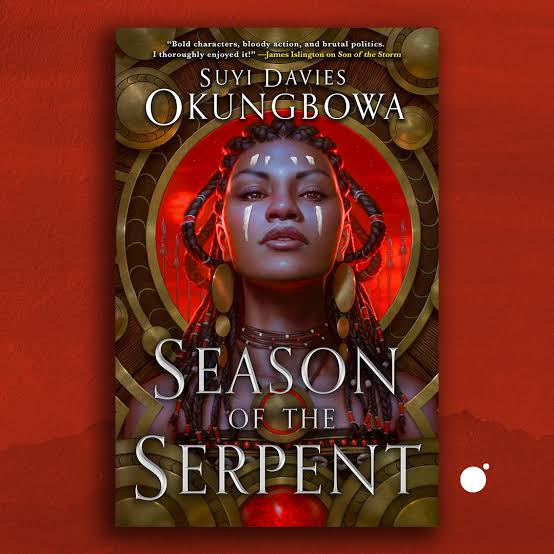
Suyi Davies Okungbowa closes out The Nameless Republic trilogy with Season of the Serpent, and while the book has no shortage of wars, factions, and monsters to resolve, the question that lingers longest isn't who wins. It's what happens when the people who broke a world are the ones left to build whatever comes next.
Fantasy has a habit I've always found a little too convenient: the world falls apart, the right people find themselves, a war comes and goes, and somebody eventually sets things right again. The map might look different afterward (a new ruler, an old empire in ashes), but underneath it there's usually a comforting assumption that history has a correct ending, and the story's job is to arrive at it.
Okungbowa isn't buying that, and it's a big part of why this book works.
By the time Season of the Serpent opens, there's no clean path back to anything. Bassa has fallen. The first book introduced this world; the second one dismantled it. The Nameless Republic and Kangalaland are circling each other toward war, and the characters who used to have fairly legible roles, hero, scholar, rebel, have all been bent out of shape by what they survived. Nobody gets to simply pick up where they left off, and that's the right call. A return to the old order would make the whole trilogy pointless.
What makes the book more interesting than its plot summary suggests is how unwilling it is to sort its characters into camps. Esheme is the clearest example. She resists the usual villain logic almost entirely. She isn't cruel for the sake of it or scheming toward some legible evil; she wants the world, plainly and without apology, and the novel is far more interested in what that wanting costs everyone around her than in whether she counts as good or bad. That's a harder, uglier question to sit with than a simple morality tale, and the book doesn't flinch from it.
The same scrutiny gets turned on the people nominally fighting for the right cause. The Nameless Republic grew out of resistance to older, more brutal power, but resistance doesn't automatically produce justice once it wins. Kangalaland's ambitions read easily as conquest; the Republic's read as something murkier, because the novel keeps testing its characters' political language against their actual behavior, and the two don't always match.
This is where the book's West African foundations do real work rather than decorative ones. Okungbowa has talked in interviews about drawing on oral epic traditions (Sundiata, the Chaka stories) and folding them into the architecture of secondary-world fantasy, and about caring more for character and interiority than for building an exhaustive, catalog-style invented culture. That distinction shows on the page. Plenty of fantasy novels can claim non-Western influence as a selling point; fewer let that influence actually reshape how the story thinks about power, legitimacy, and the aftermath of revolution. This one does. History here isn't scenery. It's something people carry: memories of the war, resentments left by defeat, the new losers a political settlement always creates. There's no reset button, and no guarantee that surviving one regime makes you wiser under the next.
That philosophy also explains a shift some longtime readers of the series may not love: Danso, whose curiosity drove much of the trilogy's momentum, isn't really the center of gravity anymore. Lilong and Kakutan take on much more weight, and older figures like Biemwensé come further into focus. I understand the frustration (Danso was the reader's way into this world), but I think it's the right choice for a story about a world outgrowing any single person's version of it. He got us into Oon. He was never obligated to be the one who explains what Oon becomes.
There's also something almost contrarian about the book's scale. It's carrying a lot: competing states, old magic, active war, shifting alliances, personal betrayals, the accumulated weight of two previous novels. And yet it clocks in at 368 pages, notably lean for a trilogy capper with this much business to finish. At times I wanted it to slow down. The trilogy has earned moments that call for stillness rather than another revelation or political maneuver, and the pace occasionally outruns the emotional beats it's just set up. But the momentum isn't aimless; it's characters dragging the consequences of earlier decisions toward each other, which is a different, and ultimately more satisfying, kind of propulsion than plot for its own sake. It's also why the ending lands: after all the political machinery, the book's real center of gravity is the relationships: people scattered across the map for two books, finally back in the same room.
Epic fantasy tends to promise you a saved world. What readers usually care about is who's left standing in it, and on that count, Season of the Serpent delivers. The title's serpents show up, literally and otherwise, but the more persistent danger in this trilogy is subtler: the tendency to mistake possession for stewardship. The person who wants to rule can sincerely believe ruling and repairing are the same thing. The revolutionary can become just another kind of administrator. The scholar can learn that knowledge doesn't make him good. None of these are villainous positions in isolation, which is exactly what makes them dangerous.
Okungbowa has spent roughly a decade building this world, since around 2016, and it would have been easy to end it on the usual consolation: the world was broken, the heroes suffered, evil lost, and now the future belongs to the good guys. He doesn't give us that. Instead we get something less comfortable: a world rebuilt without necessarily being better, a revolution that succeeds without becoming just, survivors who make it through without becoming heroes for having done so.
That refusal to resolve cleanly is what makes the ending feel earned rather than convenient. After the battle, after the magic and the collapsing empires, somebody still has to live there and figure out what comes next. That's where Okungbowa leaves us, and it's the right place to stop.
 WhatsApp
 X
 Facebook
 LinkedIn