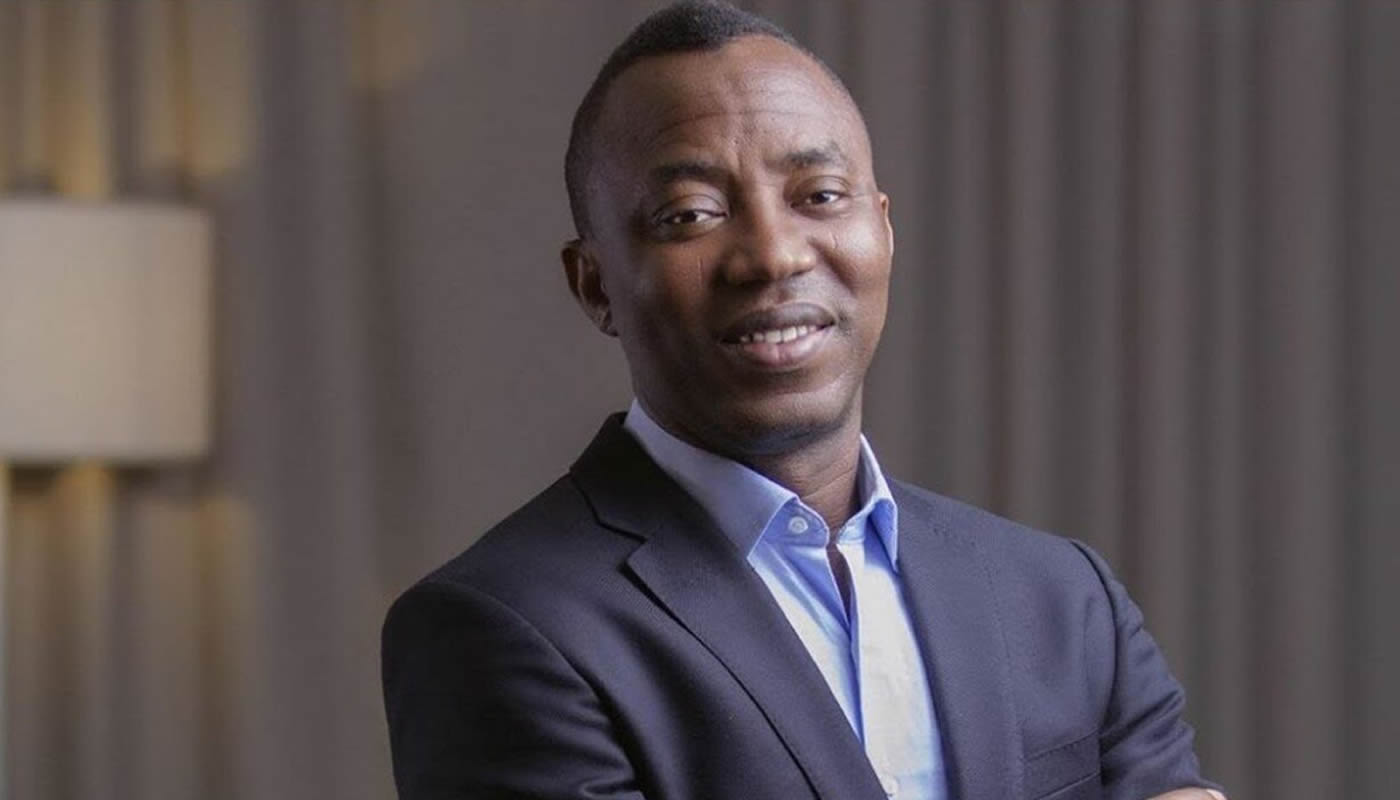
On 1 June 2026, African Action Congress presidential candidate Omoyele Sowore went on X to call Bola Tinubu lethargic and clueless, and he had two specific, checkable failures in mind. Following the Plateau State killings, he vowed to deploy 5,000 AI-enabled surveillance cameras and the violence persists, Sowore wrote, adding that after the abduction of schoolchildren in Oyo State, Tinubu announced the deployment of 1,000 forest guards, but kidnappings continued. Both of the programmes Sowore named were real and specific enough to check, so this publication checked them.
The camera promise came first. Two days after gunmen killed at least 27 people in the Angwan Rukuba district of Jos North on 29 March 2026, Tinubu travelled to the city and told stakeholders his government would immediately install a network of over 5,000 cameras to help law enforcement agencies identify troublemakers instantly. He handed responsibility to Minister of Communications, Innovation and Digital Economy Bosun Tijani, who said the rollout would begin in Jos before expanding statewide, building on systems he described as already working in Lagos and Enugu. At the same event, Plateau Governor Caleb Mutfwang thanked the president for approving 1,000 forest guards for the state.
Six weeks later, a second, unrelated crisis produced a near-identical response. On 15 May 2026, gunmen abducted pupils, teachers and staff from three schools in Oriire local government, Oyo State, a total of 46 people according to later reporting. Tinubu's chief of staff, Femi Gbajabiamila, led a delegation to the affected communities and announced the president had approved another 1,000 forest guards for Oyo, on top of a specialised rescue operation. The Nigeria Union of Teachers, unconvinced that approvals alone would bring the children home, declared an indefinite strike across the state's schools from 1 June, the same day Sowore posted his criticism.
The Oyo case resolved first, and it resolved in a way that complicates Sowore's own framing as much as it complicates the government's. The children and teachers were freed on 10 July 2026, 56 days into captivity, after what the military described as an intelligence-led operation that tracked the kidnappers' network to hideouts inside the Old Oyo National Park forest and arrested eight suspects. Nowhere in the army's account, relayed by presidential spokesperson Bayo Onanuga, do the newly approved forest guards feature. The rescue appears to have been achieved by conventional troops and intelligence work, not by the 1,000-guard programme announced seven weeks earlier, which raises a question neither side has really engaged with: if the guards were not what got the children out, what exactly did the approval accomplish in the meantime?
Some independent reporting suggests an answer, and it is not flattering to the pace of the wider programme. Plateau and Oyo's guards were folded into a national Presidential Forest Guards Initiative that Tinubu first floated in February 2024 following a meeting with state governors, directing states to recruit between 2,000 and 5,000 guards each. A team of eleven Daily Trust reporters, filing from Borno to Benue to Taraba in June 2026, found a programme that varies wildly by state and rarely resembles the "immediate" language used when new tranches are announced after an attack. In Borno, guards told reporters they had been receiving allowances for five months but were still waiting for weapons and operational directives from the Office of the National Security Adviser. In Taraba, residents in three separate local government areas said they had not seen a forest guard at all despite farming season having started. In Benue, the state's own environment ministry said it had no knowledge of any recruitment exercise, even as a security adviser separately confirmed recruits were mid-training. Kwara's guards were the most visibly active of any state surveyed, engaged in real joint operations with the police, and paid for that visibility with at least 12 guards and vigilantes killed in a single attack in September 2025. None of this is proof that the Plateau and Oyo tranches specifically are stalled in the same way, since they were only approved in April and June respectively and Daily Trust's reporting predates full rollout in either state, but it is the only independent, on-the-ground account of how this programme tends to perform once the cameras leave the press conference, and it gives Sowore's "kidnappings continue" line more evidential weight than his tweet alone supplied.
The camera programme is harder to check, because unlike the forest guards it has not yet attracted an equivalent independent audit. No government agency has published an installation count, a coverage map or a completion date for Plateau's 5,000 AI cameras, and this publication could not locate one in the seven months since the announcement. What is on record is the reaction the promise itself generated in Jos, where residents pointed out that Tinubu's own condolence visit was cut short because the local airport could not keep its runway lit after dark, a detail Peter Obi later invoked in a different context to make a related point about the distance between official rhetoric and basic infrastructure. Whether or not 5,000 cameras have since gone up, the more basic promise buried inside that announcement, that Plateau's security response would be powered by functioning digital infrastructure, was undercut by the state of the power grid on the day it was made.
Violence in Plateau, meanwhile, did not pause for either programme. On 18 August 2026, gunmen killed at least 25 people, mostly women and children, in an attack that prompted the Northern Senators Forum to issue a statement calling for increased investment in drones, CCTV cameras and early warning systems at known flashpoints, the same tools Tinubu had already announced five months earlier. Ten days later, attackers struck multiple communities in Riyom, Barkin Ladi and Mangu local government areas on the same night, killing a Ghanaian-Nigerian pastor among others. A senators' forum publicly asking for infrastructure the government says it already ordered installed is either a sign that the request has moved past the original announcement into something more specific, or a sign that five months on, the cameras are not yet doing whatever cameras are meant to do in a crisis like this one. Neither reading is good news for the original promise.
Sowore's own platform is where this gets harder to referee cleanly, because he has not confined himself to critiquing other people's technology promises. In late July 2026, he unveiled a manifesto plank proposing that artificial intelligence serve as Nigeria's Minister of Finance and a drone as Minister of Defence, arguing the AI would eliminate human manipulation, waste and corruption in public finance through data-driven decisions, and that the drone would redefine national security through modern surveillance and rapid response. The proposal drew immediate scrutiny over how either idea would function inside Nigeria's constitutional structure, which requires ministers to be human beings confirmed by the Senate, and Sowore has not published anything resembling the operational detail he is demanding from Tinubu's camera and forest guard rollouts, no procurement plan, no timeline, no account of who would actually operate the drone or audit the AI's decisions.
We sent requests for comment to the Ministry of Communications, Innovation and Digital Economy on the status of the Plateau camera installation, and to the Office of the National Security Adviser on the current deployment figures for forest guards in Plateau and Oyo specifically. Neither had responded by the time of publication, which is itself consistent with what Daily Trust's reporters found when they tried the same thing in June: the office overseeing the national guards programme did not return their calls either.
What is left, seven months on, is two security promises that were real, specific and urgently worded at the moment they were made, and a candidate attacking their absence who has since made a promise of his own that is considerably less specific and arguably less grounded in what Nigeria's constitution actually permits. Both facts can be true. Nigerians in Jos and Oriire are entitled to ask what happened to the cameras and the guards they were told about in April and May. They are equally entitled to ask a man who wants their vote in 2027 how, exactly, a drone gets sworn in.
 WhatsApp
 X
 Facebook
 LinkedIn