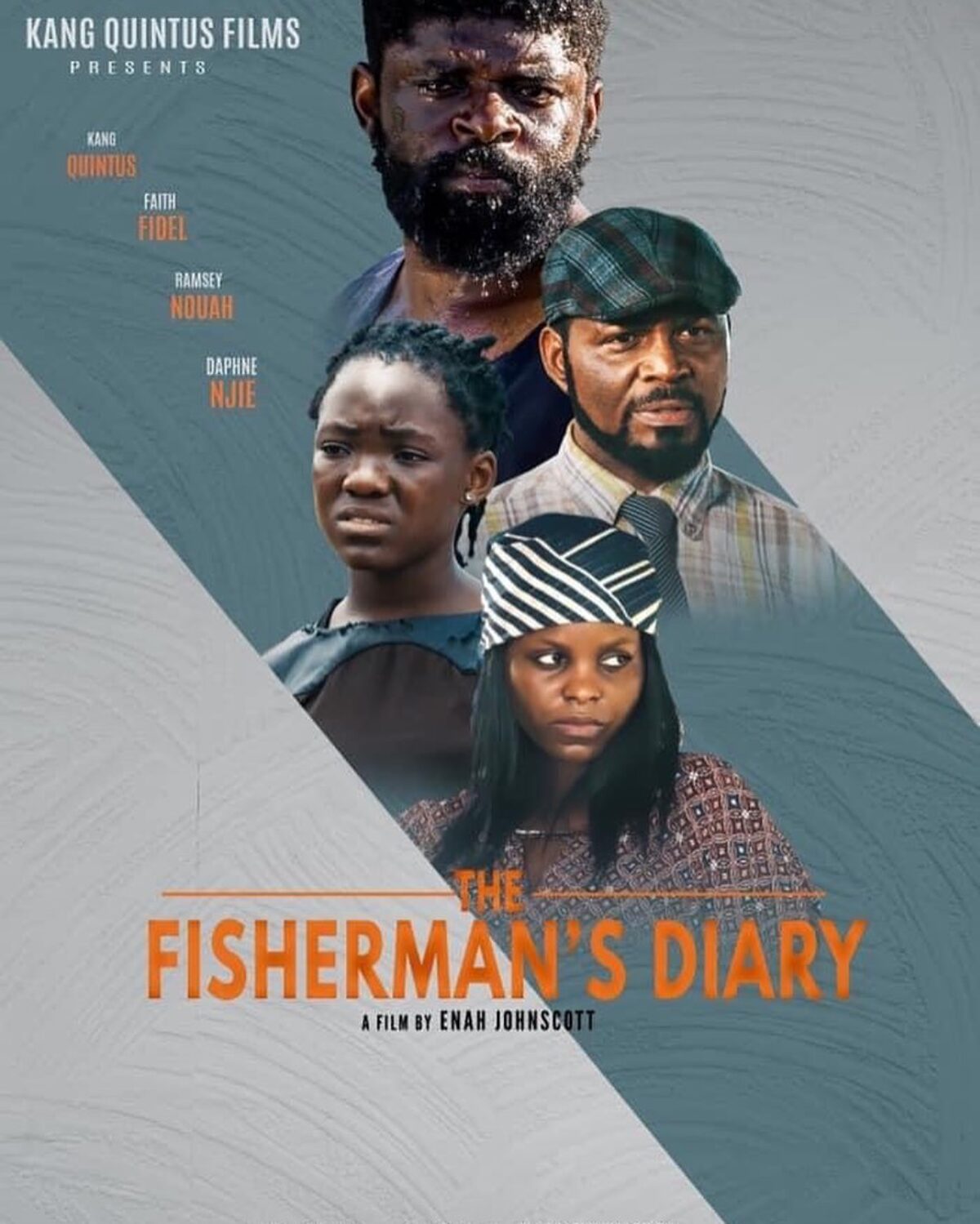
I am sure that it is difficult to see how people treat something such as the desire to go to school as a crime. It is precisely this idea that the director of The Fisherman's Diary wanted to convey. It is the story of a 12-year-old girl, Ekah, who refuses to accept that it is not acceptable to have a different life just because one was born a girl.
Ekah is a young schoolgirl who desperately wants to attend classes. Having heard about the Pakistani Malala Yousafzai, she wants to follow her example even more. The main heroine's father, Solomon, does not share his daughter's aspirations. In his opinion, there is no need for education for girls, and the stronger Ekah's protest becomes, the more strained their relationship becomes.
Actually, there is nothing complex about this story. Moreover, it is revealed in the film very clearly from the very beginning. But this is not an obstacle. Indeed, Ekah's case is easily understood by the viewer, and it becomes easier thanks to the director's choice.

Faith Fidel is amazing here. First of all, the actress is good because she plays Ekah not as a small but confident activist who knows everything. She is just a child. Sometimes she becomes excited, sometimes scared, sometimes furious. In particular, there is something in her conversations about school: she is not able to understand why something so usual can be taken from her. This is exactly the peculiarity of the character.
Kang Quintus also deserves attention, although not in the same manner. Solomon is an awful father, but the movie does not present him as an absolutely bad person. He has some affection towards his daughter despite his cruel ideas. This makes his scenes with her uncomfortable because it is clear that there is still something in their relationship beyond constant disagreements.
And it seems that the film is full of these disagreements.
Sometimes The Fisherman's Diary looks like a movie trying very hard to convey its idea. You get it, then the film interprets the idea, and then someone explains it once again. It is clear that the problem is not that the film is conveying incorrect ideas. It is just that there is no need for it.
The desire to attend school is enough.
All the characters don't have to speak about the importance of education. You are able to see it in the girl's eyes when she speaks about it, in the eyes of her teacher who supports her, and in the eyes of her father who tries to stop her. These scenes are more powerful than some of the film's monologues.
That is probably the major drawback of this movie. Actually, it is quite good, but it often fails to trust its story.
The running time also does not help the movie. More than two hours of the film are required to convey the main idea, and not all of this time seems to be necessary. Of course, there are several reasons why this is needed. For instance, this additional time allows the community to be presented as it really is instead of just being the background to Ekah's problems. However, not all of it is necessary.
Despite all that, there are several unforgettable scenes in the movie.
The relationship between Ekah and her teacher can be called such a scene. It is good to see how an adult takes a child's ambitions seriously when almost everybody thinks that these ambitions are nothing. Ekah is not asking for any privileges. She just needs to be told that she is allowed to be ambitious.
This is why the story is so tragic. Nobody is asking her to give up her unrealistic dreams. She wants an education.
The film is also good in that it shows that Solomon's attitude towards his daughter is not isolated. It is a part of the community where girls have to obey certain expectations. Thus, Ekah is not struggling just with her father. She opposes the whole community.
The fishing community is also giving the movie some of its character. The setting is one of the things that prevent the film from looking like a story that could be presented anywhere. There is something of everyday life around Ekah, and this makes her story feel more real.
Unfortunately, the film becomes less convincing at the moment when it is trying to find an emotional ending. There is a moment when you feel that the filmmakers are saying, "it is the moment where you must be touched". I would prefer it if the film had relied on what had been shown earlier.
This happens at several moments throughout the film. Everything is working perfectly until somebody says something and the meaning suddenly becomes obvious. This deprives the scenes of their naturality.
However, I would prefer to watch a film that cares too much about its idea than one that has nothing to say.
The Fisherman's Diary is clearly a movie with a certain aim. It wants to speak about the denial of education to girls, about fathers transmitting their beliefs to their children, and about what happens when a young person begins doubting the life chosen for her. It is sometimes clumsy, but the theme deserves to be taken seriously.
And Faith Fidel gives the film a good reason to watch it. Ekah is stubborn without becoming annoying and vulnerable without becoming helpless. You want her to win because she wants nothing unreasonable. She wants to be in the classroom.
And this is the reason why the movie is able to compensate for its flaws. The monologues can be too much. The pace of the story can drag. The ending could have used a bit of restraint. But Ekah's struggle is easy to understand and easy to remember.
Sometimes a film does not need a complicated story to make its point. A girl wants to go to school. Her father says that she cannot. She keeps trying to achieve it.
 WhatsApp
 X
X
 Facebook
 LinkedIn