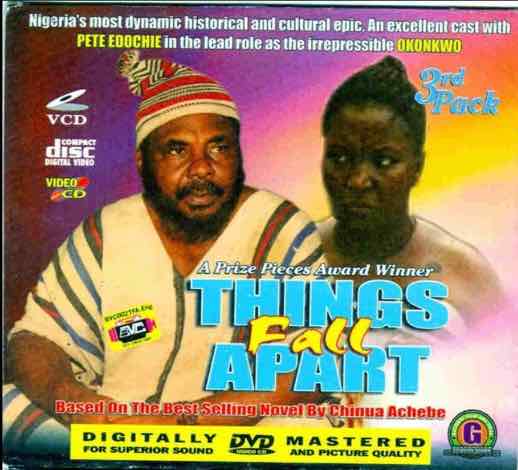
It is difficult to adapt Chinua Achebe's Things Fall Apart into television due to the importance of the novel to Nigerian literature. Yet such an adaptation did happen in 1987, and it starred Pete Edochie as Okonkwo. The series was produced by the Nigerian Television Authority and consisted of 13 episodes with a total length of around ten hours.
This series covers all of the main plot points presented in the novel. Okonkwo is a respected wrestler, farmer and leader of Umuofia who is determined to avoid the perceived weakness of his father. This stubbornness contributes to his downfall. Everything starts to change with the arrival of Christian missionaries and British colonial power.
It was quite logical to make the story in the form of a television series rather than a feature film since this format provided enough room for more details to be included. Research on the production of the series pays special attention to the portrayal of Igbo religion, administration, family life, farming, proverbs and other aspects of Igbo culture.

It is important to note that this cultural aspect of the story is one of the most interesting features of the series. In her study, Ugochukwu identifies this production as an important example of the adaptation of Things Fall Apart. Moreover, she mentions elements that became characteristic of Nigerian popular cinema, namely its interest in history, theme songs and Igbo-English code-switching.
Thus, this production cannot be seen only through the prism of Achebe's plot. It also carries the additional burden of depicting the world where this plot takes place. This makes the series particularly relevant today since the main topic of discussions about Things Fall Apart is usually colonialism and its consequences. The series pays a lot of attention to the community and its traditions before and during that disruption.
Pete Edochie's performance as Okonkwo is undoubtedly the strongest point of the production. His portrayal of Okonkwo represents a character full of strength, pride and fear. Recently, Nigerian media have paid special attention to Edochie's career and mentioned his role as Okonkwo as one of his defining roles, since he managed to portray Okonkwo's rigid attitude towards tradition and his inability to adapt as society changes.
All this helps explain the popularity of the 1987 series. Edochie became very closely connected with Okonkwo, and many discussions of the series start with his performance. The character is quite impressive; however, his tragedy lies in the fact that his strong personality prevents him from reacting properly to changes in society.
Nevertheless, the production does have its weaknesses. As noted in Film Threat, the 1987 adaptation makes some changes to Achebe's original story, including its treatment of the announcement regarding Ogbuefi Udo's wife. Moreover, it has its own distinct style that might seem strange to people who have watched other productions.
All these aspects should be taken into consideration, although it might not be necessary to pay too much attention to the issue of faithfulness. The value of the series comes partly from the fact that it is an adaptation of one of the most important works of African literature made by Nigerians. Moreover, this production has cultural significance of its own.
Ugochukwu describes it as a successful project and tries to understand why. Instead of treating it as an old version of a known story, she looks at the development of Nigerian screen culture from the perspective of this adaptation.
Thus, more than thirty years after its production, this series still remains quite interesting since it is not only an adaptation of a major African novel but also a document of Nigerian television and the Nigerian filmmaking industry.
The production style might be quite different from that of contemporary television, and there are some deviations from the original text. However, Pete Edochie's Okonkwo and the attention to Igbo culture make the series interesting and do not turn it into just a colonial-era story.
In conclusion, the 1987 Things Fall Apart series deserves special attention not only because it brought Okonkwo to television but also as an early Nigerian attempt to put one of the most important African novels on television.
 WhatsApp
 X
X
 Facebook
 LinkedIn