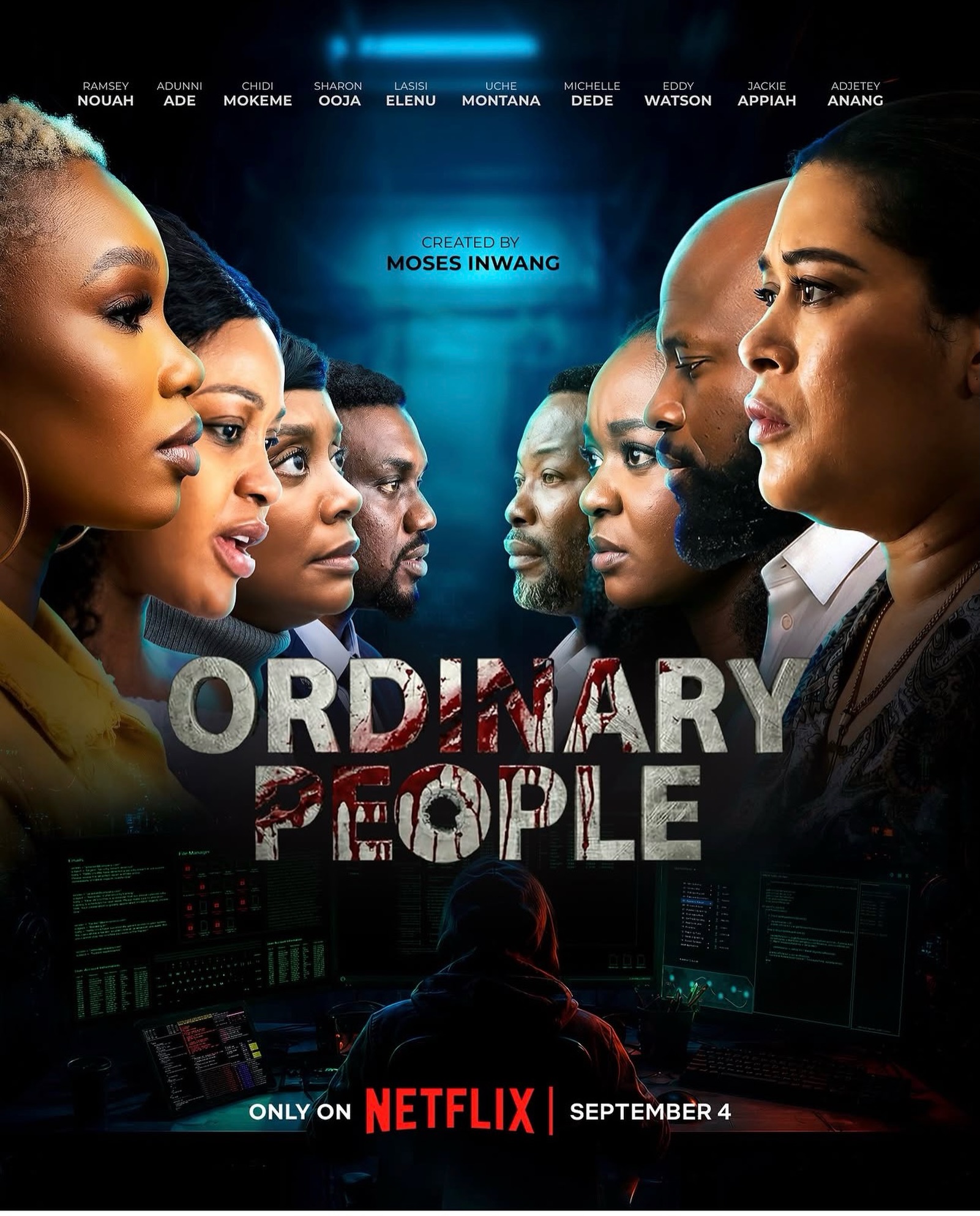
A good idea is hidden somewhere beneath Ordinary People. A fugitive criminal who was believed to be dead is hiding in an estate with his wife under a new identity. Two intelligence agents are living among the residents and looking for him. A hacker is listening to conversations of his neighbours. With such ingredients, there should be a really good thriller here. But one thing spoils all the plans: the series won't stop reminding us how thrilling the whole situation is.
Ordinary People is an eight-episode Netflix series, directed and created by Moses Inwang, taking place in Mirage Estate, where the lives of the residents appear to be ordinary until everything falls apart. Ramsey Nouah and Adunni Ade play Tornado and Chinelo. Chidi Mokeme and Michelle Dede are undercover detectives, Tolu and Margaret. Shawn Faqua is a hacker called Dare, whose interest in his neighbours' lives becomes important to the story. Good premise. The show doesn't seem to believe in it.
The main problem with Ordinary People is the amount of explaining. Dare explains almost everything–-what he learned, why he performed some action, and what the others did. Sometimes the series shows something to us, and right after it explains what it means. Once, it is fine. Twice, it gets a little bit tiresome. A thriller has to let us see something suspicious and let us ponder over it. The show can't seem to allow that. The answer comes faster than the questions appear.

The estate itself could become a good setting-–everyone has a secret there, and those secrets could've been unravelled gradually. Instead, the show stops at every step to explain them out loud, and after a while, the explanation seems to be more irritating than the mystery itself.
The role of the hacker was supposed to make him an integral part of the plot. I don't require full realism from television hacking. It just has to obey its own rules, and in this case it doesn't. We plug in a flash drive; the information appears on the screen. Cameras are accessed as if they were nothing. Telephones are hacked in seconds. It is taken completely seriously, which makes it even worse; Dare just knows everything when the script requires him to.
Too many characters too. The woman who experiences domestic abuse could become the protagonist of her own series or episode. Emilia's psychological crisis is a separate thread. Tolu and Margaret are performing their own investigation. Tornado and Chinelo are the anchors of the criminal plot. Then there are Tony and Mercy, Doctor Adebayo, and several residents of the estate, each of whom has a secret waiting to be revealed. Not one of these is a bad idea by itself. Still, there is just too much of it, and eight episodes are not enough to fit everything in. Some characters start to feel not like real people but like the next revelation in the list.
Molly wasn't needed here. The hacker drug-use subplot didn't have anything in common with the main mystery. The show already had crimes, domestic violence, undercover agents, psychological problems, and revenge.
Nouah is the strongest element of the show. The criminal transformation of Tornado becomes evident when Tornado tries to conceal his dark past in the present timeline; it is an interesting thing to watch. The estate looks realistic and inhabited. The action in some scenes has a lot of ambition behind it, although it suffers because of some poor effects and continuity problems. Mokeme is as reliable as Tolu. Ade copes with the challenging part of Chinelo very well. Even so, none of it saves a script that's stretched too thin.
By the time of the finale, the show isn't short of answers any longer; it is overloaded with them. Episode seven provides the explanations that should've been provided in the first place, which means that the finale becomes a clean-up act. That is why the ending seems to be nothing more than paperwork, not the climax. The final shootout is supposed to be the point where everything collides. Instead, it ends up as a checklist of the writers.
There are confrontations. There are twists. Yet none of them hit especially hard. It is not a bad series, although it is a little bit disappointing. There is a good cast, and you can still notice the thriller underneath it.
Still, the narration refuses to stop, the dialogue keeps explaining things that we already figured out ourselves, and the hacking is unrealistic. The show had enough material for a suspenseful thriller. Instead, eight episodes of it become increasingly tiresome.
 WhatsApp
 X
X
 Facebook
 LinkedIn